Our identity
A project that tells the authentic soul of the territory
The Patriarchs
James Morra
humble and generous person , of peasant origins, capable of combining vision and concreteness.
Starting from nothing, he quickly understood how traditional cuisine is a fundamental heritage of the area and understood the importance of promoting local products , first and foremost the Alba White Truffle , but not only. With this vision, he transformed the Hotel Savona into a point of reference and a true hub of Alba's food and wine .
A dreamer and tireless worker, he was also a far-sighted entrepreneur: in 1929 he created the first Truffle Fair , helping to promote not only truffles, but local gastronomy as a whole.
His most effective intuition was to give the Alba White Truffle international fame: he sent prestigious specimens to personalities of the time, who reciprocated with letters and telegrams, and thus managed to attract important figures from the world of entertainment and culture to Alba, including singers and actresses such as Sophia Loren .
Luciano De Giacomi
the pharmacy owned by doctors Luciano Degiacomi and Giacomo Oddero has been Alba's "living room": a place of meeting and exchange, at the heart of the city's cultural and gastronomic life.
Luciano Degiacomi is remembered as a practical visionary , capable of imagining and initiating the revitalization of Grinzane Castle , helping to clearly highlight the potential of food and wine . Along with 21 other colleagues , he is among the founders of the Order of the Knights of the Truffle and Wines of Alba over two thousand members worldwide .
Figures like Degiacomi marked a turning point in the history of Langhe and Roero : people capable of combining respect for the past with a desire to move forward, discover, and progress, transforming cultural and gastronomic insights into concrete actions for the territory.
Beppe Colla
Having arrived in Alba after the war to complete his oenological studies, he quickly established himself as one of the most progressive figures in local oenology, among the first to advocate separate winemaking as a tool for quality and identity.
He dedicated himself to defining and protecting the production areas of the Alba area , helping to clarify rules and limits, including the maximum production quantity . Together with Luciano Degiacomi, he was among the architects of the transformation of Grinzane Cavour Castle and promoted the second largest Italian wine shop of the time, after the one in Siena.
In the 1950s and 1960s , he worked continuously to strengthen the image and recognition of the entire area, at a time when building a collective reputation for Langhe and Roero was not at all easy.
Gigi Rosso
He studied at the Enologica University and, as soon as he graduated, he had the opportunity to become technical director at Cinzano , and then worked in various wineries in the area.
His love for the land and its vineyards led him to found his own winery , putting his skills and vision at the service of quality.
A rigorous and esteemed professional, he is among the founders of the Dolcetto di Diano d'Alba Consortium . A great friend of producer Renato Ratti , in the 1960s he contributed with him to the establishment of the DOC and DOCG regulations , a crucial moment for the recognition of the denominations.
A passionate communicator, he talks about wine in an engaging way, combining technical aspects with the imaginative dimension that comes from passion.
Finally, together with Giacomo Oddero , he founded the Easter Wine Fair , which over time evolved to become the current Vinum .
Pio Boffa
His winery is located in the center of Alba : a location that once represented a strategic position for logistics and which today is a testimony to the family's tradition and history.
He is a man who dedicates his entire life to his family and to the company, founded by his great-grandfather Cesare Pio in 1881 , carrying forward its values, identity and continuity.
Together with his colleagues and friends Bruno Ceretto and Angelo Gaja , he soon understood the importance of travelling and telling the world about Piedmont: making the tradition of the great regional wines known, but also showing young producers a future direction linked to quality, food and wine and tourism .
Among the first to sell their wines on international markets, they use travel as a tool for work and storytelling: a way to pass on passion and history, promoting their wines, their family, and their company.
Roberto Pontius
Born in Neive in 1923 , into a modest family. After the war, he and his wife Maria a chicken shop at 26 Via Maestra in Alba.
In the 1950s, he saw the opportunity to specialize in the Alba truffle . The shop transformed into a true boutique: the prized underground mushrooms were displayed like jewels, and sales were accompanied by a written and documented guarantee attesting to their exclusively local .
Every year, the most significant truffle in terms of weight and quality is donated to international personalities , helping to strengthen the fame and knowledge of the symbolic product of the area.
Ponzio also understood, well in advance, the importance of ecology for the survival of truffles and coined the phrase "no trees, no truffles ." At the same time, he also promoted Sunday opening times for city businesses, a strategic choice for welcoming tourists who, even in late autumn, flock to Alba on Sundays.
Raoul Molinari
Raoul Molinari is remembered as the first director of the Tourist Board , among the first to understand how essential it was to offer visitors engaging, fun experiences that were at the same time rooted in the local culture.
He is among the pioneers in the promotion of hazelnuts , truffles , wines and a type of tourism now defined as “ experiential ”: he always brings a creative contribution capable of involving people and livening up the squares.
A profound connoisseur of the Langhe and Roero , a food and wine enthusiast and friend of the area, he also knows how to highlight the figures and traditions that represent its soul: from truffle dogs to seekers , told and promoted as a living heritage.
He is a man remembered for his many ideas, often simple and brilliant, all aimed at giving tourists an authentic experience, with an innovative approach deeply rooted in local identity.
The pantalera
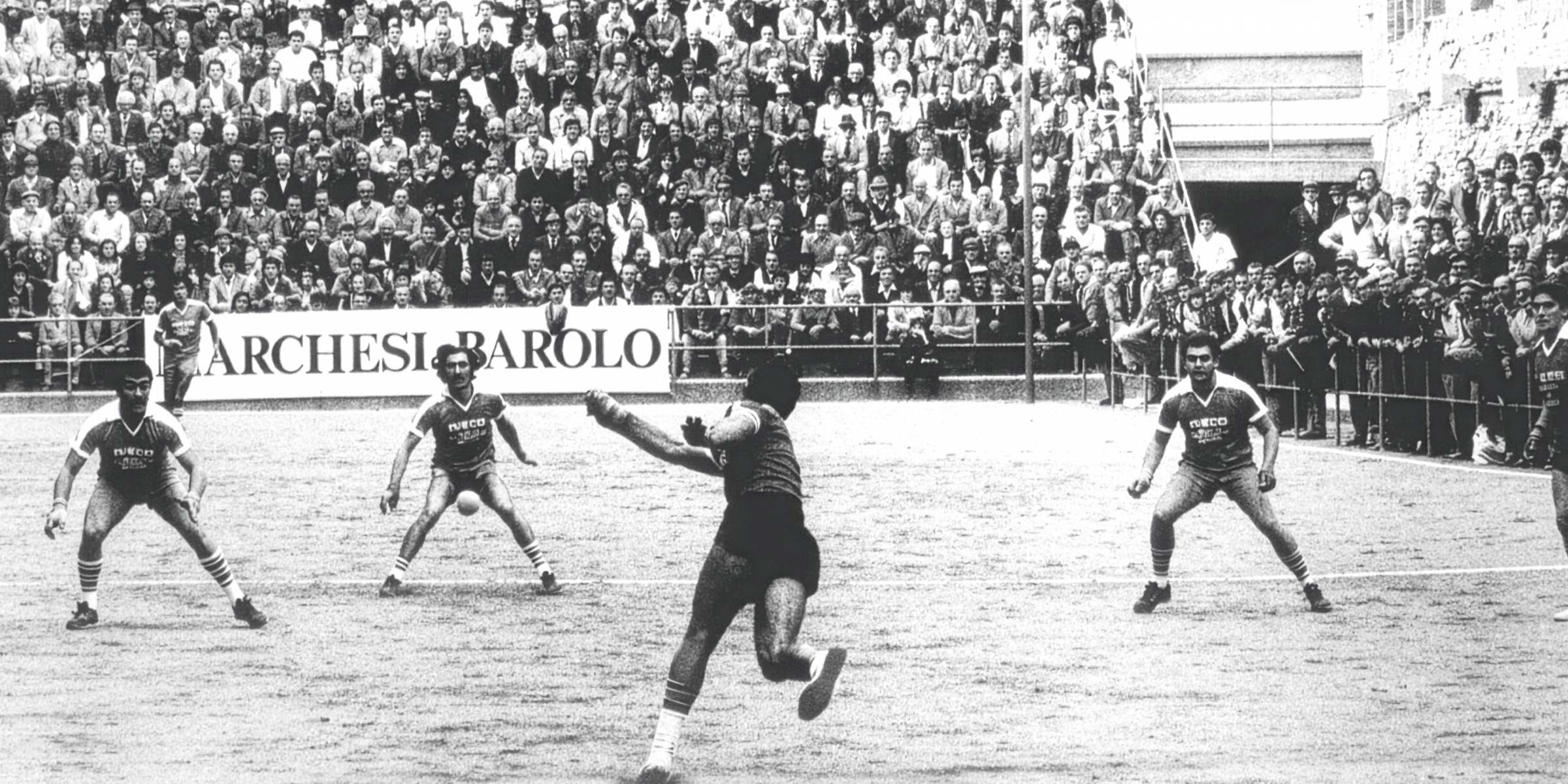
1927, Monforte d'Alba square: but what sport were Paris Rizzieri and Stefano Rabino involved in?
In the pantalera , the most traditional street game of the Langa and Lower Piedmont .
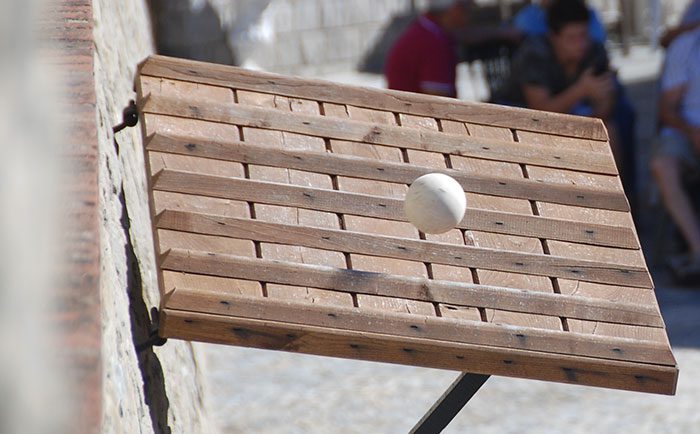
"Pantalera" is a word of uncertain origins, but its heart is very clear: a slanted wooden plank , just under two meters long, fixed to a wall. From there, the campau throws the ball and the game comes to life.
The ball is a crucial detail: 10.5 centimeters in diameter , 190 grams of rubber. An unpredictable trajectory that cuts through the squares and animates a unique sport, made up of living, often "creative" rules that deeply express the identity of a region.
In pantalera, reflexes and experience count more than physical strength. And the playing fields : the squares of Langhe, Roero, and Monferrato , often long and narrow; sometimes simple open spaces in the heart of a village, other times high up, on the top of a hill.
Reducing the pantalera to a simple street sport would be limiting, however: for many communities in the Langa, in times marked by “terra grama” , it was also a collective ritual and one of the few moments of leisure and socialization, capable of bringing people, stories and the town together.
Submit your cultural event.